How Far Away Is a Cure for Herpes? The 2026 Pipeline Explained
|
Published by PositiveSingles, the largest dating and support community for people living with herpes and other STDs. Explore PositiveSingles website or download its app for iOS or Android. Sources checked: October 19, 2026. If you’re living with herpes, news about a possible cure can bring both hope and questions. Researchers are exploring new medicines, vaccines, and gene editing—and some approaches have reached human studies. But how close are we to a cure, and what could these developments mean for you? [3,4]
There is no reliable date for when a herpes cure might become available. Still, research is moving forward. Some programs aim to reduce outbreaks and make treatment more convenient, while others investigate ways to target the virus that remains in the body between outbreaks. [3,4,7] On October 7, 2026, Herpes Cure Advocacy, a nonprofit organization, published its Herpes Cure Pipeline 5.0 report. The report tracks selected HSV treatment, vaccine, and gene-therapy programs, covering both human trials and earlier laboratory research. It offers a snapshot of what is advancing and where challenges remain. [3] In this herpes cure update, we explain what the 2026 findings mean: which approaches could make herpes easier to manage, which aim toward a cure, and what researchers still need to establish before experimental options could become available. Key Takeaways
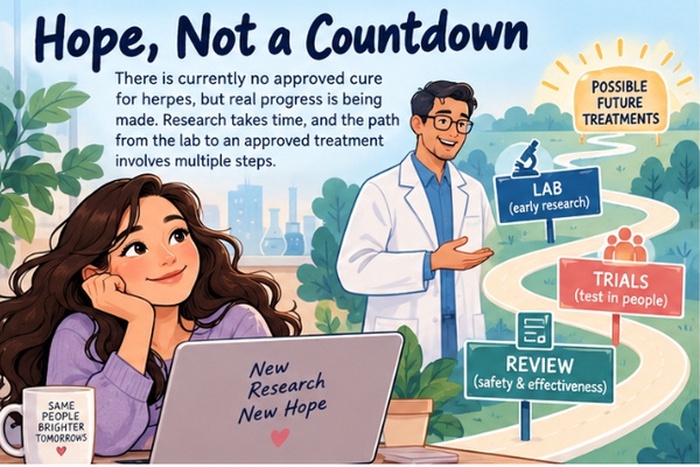
How Far Away Is a Cure for Herpes?There is no dependable countdown to a herpes cure. Before a promising discovery can become a treatment, researchers need to show that it is safe, works in people, and can be used in practice. Animal studies help guide that work, but human studies are needed to find out whether the benefits carry over. Reducing the amount of virus is only part of the picture. Researchers also need to know how long the benefit lasts, what side effects occur, and whether it improves symptoms or reduces viral shedding—the release of virus from skin or mucosal surfaces, such as the lining of the mouth or genitals. Trial completion dates are not release dates. A study may finish without demonstrating sufficient benefit, and even positive results can require further studies before regulatory review. Approval in one country also does not mean a treatment is available everywhere or suitable for everyone. Will There Ever Be a Cure for Herpes?A future cure may be possible, but research cannot guarantee it. Scientists are investigating ways to target HSV inside the nerve cells where it remains. Gene editing is one approach: it uses tools designed to cut or change viral DNA. [4] These findings give people reasons to keep watching. But researchers still need to work out how to deliver a treatment safely and make sure it works well enough in people. Some promising projects may not reach that point. Instead of asking whether one headline proves a cure is coming, ask: What was tested? In whom? What improved? And what remains unproven? Why Is Herpes Hard to Cure?
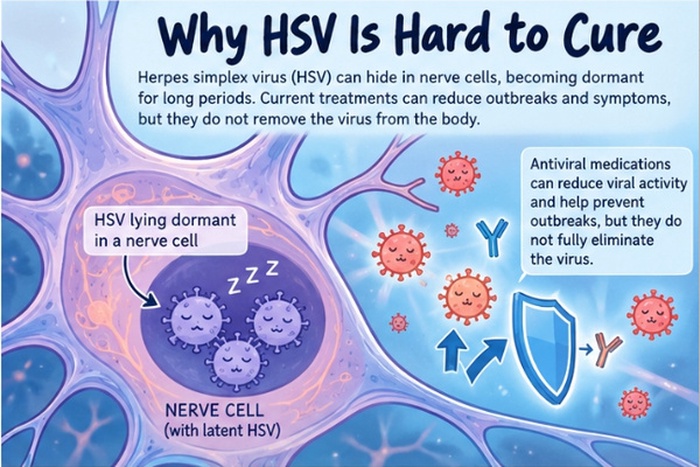
Treating an outbreak and removing the infection are two different challenges. HSV can remain dormant in nerve cells and later become active again. This dormant state is called latency. Symptoms may disappear, but the virus remains in the body. [2,4] Medicines such as acyclovir and valacyclovir help control the virus when it is actively copying itself, but they do not remove the viral DNA that remains dormant inside nerve cells. That is why treating an outbreak and curing the infection are different challenges—and why researchers are exploring ways to target the dormant virus. [2,4] What Is the Herpes Cure Pipeline 5.0 Report?Herpes Cure Advocacy released Pipeline 5.0 on October 7, 2026. It tracks 11 selected programs: one under FDA review at release, five grouped within human development, and five in earlier laboratory or animal research. Some are preparing for their next trial. The report covers prevention and treatment as well as potential cures, and does not include every HSV project worldwide. [3] An update since the report: Pritelivir was listed as under FDA review on October 7. Approval was announced two days later under the name HOVILPRI for certain herpes sores that have not responded to other medicines in adults with weakened immune systems. [5,12] What Do the Research Stages Mean?Preclinical research happens in the laboratory or in animals. Phase 1 generally focuses on safety and dosing in people; Phase 2 explores benefit and continues safety testing. Phase 3 usually tests effectiveness and safety in larger studies. Completing a stage does not guarantee that a treatment will move to the next one or receive approval. Herpes Research Programs at a GlancePrograms in Pipeline 5.0, with verified updates where available. Earlier-stage entries follow the report; registry records can lag behind developments.
What Advanced—and What Stalled?Pipeline 5.0 reports that GSK and Moderna stopped developing their vaccine candidates. Other programs were removed from its selected list because there was not enough recent public information showing progress. Removal from a report is different from a confirmed decision to stop development. [3] Setbacks do not mean all research has failed, but they show why a list of candidates cannot reliably predict a cure date. Could Better Antivirals Help Before a Cure?Better medicines could make a difference before a cure arrives. Fewer outbreaks or fewer doses would matter to many people, even if they still needed treatment. Several newer medicines are helicase–primase inhibitors. They block a group of viral proteins that helps HSV copy its DNA. This is a different way of interrupting the virus's reproduction from familiar medicines such as acyclovir. [9] Pritelivir: A New Option for a Specific Patient GroupPritelivir is approved for herpes sores on the skin or mucosal surfaces that have not responded to acyclovir, valacyclovir, or famciclovir in adults with weakened immune systems. This applies whether or not drug resistance has been documented. [5,12] For eligible patients, this provides a new treatment option. Its approval does not make it a routine replacement for valacyclovir for everyone with genital herpes. Adibelivir / IM-250: Moving Into Human StudiesA 2023 IM-250 study found improvements in recurrent herpes and viral reactivation in animals. Human studies are needed to see whether similar benefits occur in people. [10] The developer announced that the first participant received adibelivir in a Phase 2a trial in June 2026. The human study is an important next step, but does not yet establish lasting control without medication. [6] GS-1179 and GS-5366: Research Into Less Frequent DosingGS-1179 and GS-5366, previously called ABI-1179 and ABI-5366, are being studied as longer-acting antivirals. Assembly Biosciences reports that both reduced viral shedding and genital lesion rates compared with placebo in early human studies. Their results support further investigation of weekly dosing, with potential monthly dosing for GS-5366. Gilead selected GS-1179 for Phase 2 development. [7] One finding attracted particular attention: in a Phase 1b cohort receiving GS-5366 once weekly, researchers reported a 94% reduction in HSV-2 shedding compared with placebo over 29 days. This was an encouraging early result, not a cure rate or evidence that transmission fell by 94%. [14] For people managing recurrent herpes, fewer doses could make treatment more convenient. Larger and longer studies are still needed to establish the benefits and safety. Can Gene Editing Remove Herpes From the Body?Gene editing has reduced dormant HSV in animal studies, but it has not established an available cure for people. Researchers are working on how to deliver it safely and effectively. [4] What Fred Hutch's 97% Finding Actually MeansA 2024 mouse study found approximately 97% less dormant viral DNA in affected clusters of nerve cells after treatment, compared with untreated mice, in a model of genital infection. The virus in that experiment was HSV-1, not HSV-2. Researchers also found less shedding when they triggered the virus to reactivate in their experiments. [4] This does not mean 97% of patients were cured. Some experiments showed liver toxicity at high doses and subtle signs of nerve-cell injury. Changes to the treatment improved how well the animals tolerated it. [4] NIH-funded work also aims to adapt this approach to HSV-2 through laboratory and animal testing. The funding helps researchers test the approach; it does not mean it has already worked. [11] BD111: Human Research for HSV-1 Eye DiseaseBD111 is being studied for HSV-1 stromal keratitis, an inflammatory condition affecting the cornea—the clear front surface of the eye. Its registered Phase 2a trial delivers the therapy directly into the cornea. The registry was last updated in May 2025. Results from this specific eye treatment cannot automatically be applied to genital or oral herpes. [8] It is worth watching because herpes gene editing has reached human studies, while remembering who the treatment is intended to help. What Would Count as a Herpes Cure?When reading herpes research updates, it helps to understand what researchers mean by a “cure.” The table below explains how removing the virus differs from controlling it over time.
These terms describe different goals. A treatment that reduces outbreaks should not automatically be called a cure. “Functional cure” does not yet have a universally agreed definition for HSV, and no approved HSV treatment has established that outcome. Look for explanations of how long the benefit lasted, whether medication continued, and whether the study measured transmission—not just symptoms or shedding. Where Do Herpes Vaccines Fit?A preventive vaccine aims to protect someone before infection. A therapeutic vaccine aims to help someone who already has the virus, for example by reducing outbreaks. These are different goals. [3] BNT163 shows why it helps to look beyond the label. Although developed as a preventive vaccine candidate, its Phase 1 study also includes people with recurrent HSV-2 genital herpes, studying safety and immune responses. Recruitment is complete, according to the sponsor, but that does not mean final results are available. [13] Producing antibodies shows that the immune system responded. To know whether a vaccine protects against infection or reduces outbreaks, researchers need studies measuring those benefits. What Should We Watch for Next?
When reading a breakthrough headline, check the evidence date as well as the publication date of the article. A 2026 post may be discussing a 2023 experiment. Managing Herpes While Research ContinuesYou can get help now, even while cure research continues. A healthcare professional can discuss medicine for outbreaks or daily treatment to reduce recurrences, depending on your situation. For genital herpes, partner communication, condoms, and avoiding sexual contact during sores or warning symptoms such as tingling or burning are part of reducing risk. Condoms do not cover every potentially infectious area. Daily treatment can lower the chance of passing on HSV-2 in studied situations, but cannot remove that risk. Evidence for preventing genital HSV-1 transmission this way is more limited. [1,2] Seek prompt medical assessment for a first suspected outbreak, eye symptoms, or severe illness, and discuss HSV with your clinician during pregnancy or if your immune system is weakened. Do not stop prescribed treatment or substitute an experimental product on the basis of cure headlines. Final Thoughts: Finding Hope and Connection TodayIt’s understandable to hope for a herpes cure. But your relationships, confidence, and plans for the future do not have to wait for a research breakthrough. Learning how to manage herpes and talk about it with a partner can help you move forward at your own pace. If you’re ready to connect, PositiveSingles offers a community where you can meet others living with herpes and other STIs, share experiences, and explore dating. If disclosure feels like the hardest step, our guide to telling someone you have herpes can help you prepare.
You can follow the research with hope while making room for connection today.   Explore PositiveSingles on the web? Sign In This article provides general information about herpes research and is not a substitute for medical advice, diagnosis, or treatment. Consult a qualified healthcare professional about your individual circumstances. Sources
|