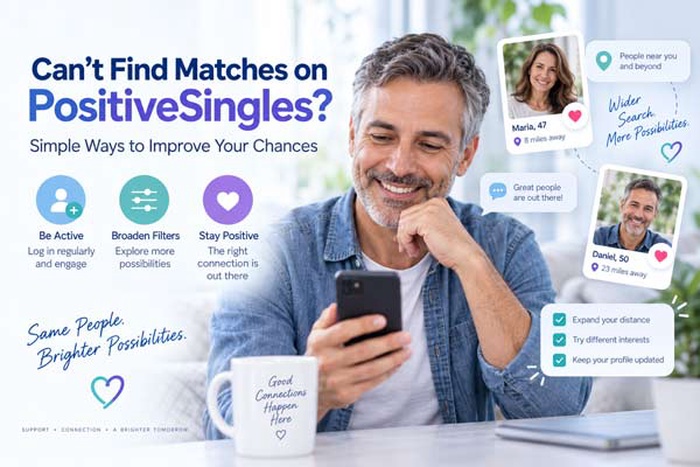
Can't Find Matches on PositiveSingles app? 7 Ways to Improve Your Chances
|
If you can't find matches on Positive Singles app, it does not necessarily mean there are no compatible people for you. Sometimes the problem is much simpler: your search area is too small, your filters are too strict, your profile has not been updated recently, or you are waiting for other members to make the first move. PositiveSingles serves a more specific dating community than a mainstream dating app, so the number of people within a very narrow location or preference range may naturally be smaller. That makes flexibility, profile quality, and consistent activity especially important. A few practical changes can often help you discover people you would otherwise never see.
Dating after an HSV, HPV, HIV, or other STD diagnosis can already come with extra emotional pressure. When matches do not appear quickly, it is easy to interpret a quiet week as rejection or assume that online dating simply is not working. In reality, matching is affected by many small factors, including geography, search settings, activity level, photos, profile information, and how you start conversations. Instead of changing everything at once, it is usually more useful to look at each part of your approach and make thoughtful adjustments. Why Am I Not Getting Matches on PositiveSingles?One of the first things to understand is that PositiveSingles is a specialized dating community. Unlike a large mainstream app that may show thousands of people in almost any metropolitan area, an STD dating platform serves a narrower audience. If you combine that smaller dating pool with a short distance radius, narrow age preference, specific relationship status, exact lifestyle requirements, and several other filters, you may unintentionally hide many potentially compatible members. The issue may not be that people are unavailable. Your search settings may simply be making them difficult to find. Imagine someone living in a smaller city who searches only within 10 miles, limits the preferred age range to five years, and selects several additional criteria. There could be interesting people 25, 40, or 60 miles away who never appear in that search. Another member may be a year outside the chosen age range but share the same relationship goals, hobbies, personality, and communication style. Dating filters are useful, but every additional requirement reduces the number of profiles you can discover. Your own activity matters as well. Logging in once, looking through a handful of profiles, and then disappearing for two weeks gives you fewer opportunities to meet someone than checking in regularly and exploring new members. Online dating usually works through repeated exposure rather than one perfect search session. Someone who was not on the platform last week could join tomorrow, while another member may update a previously incomplete profile and suddenly become much more interesting. It is also worth looking at how your profile appears from the other side. A profile with one old photo and two short sentences may not give another person enough confidence to start a conversation. Even people who are interested can hesitate when they do not know what to talk about. Your profile should make it easy for someone to imagine having a conversation with you. Expand Your Approach If You Can't Find Matches Near YouIf you can't find local matches on PositiveSingles, widening your search area should be one of the first changes you consider. Distance matters, especially if you want a relationship that can realistically move offline, but an extremely small radius can work against you on a specialized dating platform. Instead of searching only a few miles from home, try gradually expanding the distance and seeing whether the quality of your results improves. You do not have to commit to a long-distance relationship simply because you view someone farther away. This is especially important for people living outside major metropolitan areas. A user in Los Angeles, Chicago, or New York may naturally have more nearby options than someone in a smaller city or rural community. If the local dating pool is limited, expanding your radius to nearby towns or neighboring cities can make a significant difference. A 45-minute drive may feel less convenient than meeting someone five minutes away, but it may be reasonable for the right person. Try not to combine a narrow distance range with too many additional search filters. It can be tempting to select exact preferences for age, height, education, smoking habits, relationship history, interests, and other characteristics because filtering feels efficient. In practice, it can become so restrictive that you repeatedly see the same small group of profiles. Start with the characteristics that genuinely matter to you, then leave room for personality and chemistry to surprise you. It also helps to distinguish between preferences and deal-breakers. Wanting someone between 52 and 58 may be a preference, while wanting a partner who is emotionally available and interested in a serious relationship may be far more important. If a 60-year-old shares your values, lives within a reasonable distance, and communicates well, rejecting that person because of a two-year age difference may not serve your larger goal. Being open-minded does not mean ignoring your standards. It means avoiding filters that eliminate someone before you have enough information to know whether the two of you might connect. On a niche dating platform, that flexibility can be particularly valuable. Be Active and Explore More ProfilesDating apps tend to work better when you actually use them as dating tools rather than treating them like a directory you check occasionally. Set aside a few minutes several times a week to browse profiles, look at new members, revisit people you may have overlooked, and read more than just the first photograph and headline. Sometimes the most compatible profile is not the one that instantly jumps off the screen. Attraction can grow when you discover someone's humor, interests, values, or life story. Consider a member who initially skips someone because their main photo seems ordinary. A week later, they read the full profile and discover that both love weekend road trips, rescue dogs, jazz concerts, and quiet Sunday mornings. Suddenly the profile feels completely different. This happens because compatibility is rarely communicated through a single photograph. Being active also helps you understand what you actually respond to. After viewing more profiles, you may realize that some requirements you originally considered important barely influence attraction. You may also identify qualities that matter more than expected, such as thoughtful writing, emotional maturity, family values, or a willingness to communicate openly about health. Try to approach browsing with curiosity instead of constantly asking whether every person is your ideal partner. At the beginning, your only real decision is whether you would enjoy having one conversation with someone. That is a much easier and more realistic standard. Don't Wait for Every Conversation to Come to YouOne of the easiest ways to reduce your dating opportunities is to wait for other people to initiate everything. Many users are doing exactly the same thing. They may view your profile several times, find you attractive, and still hesitate because they are nervous about rejection or unsure how interested you are. When two interested people both wait, nothing happens. Sending the first message does not mean you are chasing someone. It simply tells the other person that you noticed them and are open to a conversation. This can be particularly helpful in STD dating, where some members may already feel cautious or vulnerable because of previous rejection experiences. A friendly message can remove some of that uncertainty. You also do not need to turn every profile view or message into a major emotional investment. Think of an opening conversation as a simple introduction. Some exchanges will end quickly because the chemistry is not there, while others may grow naturally over several days. The goal is not to force every interaction into a relationship. It is to create enough genuine conversations that the right connection has a chance to develop. A member who contacts three thoughtful profiles during the week will generally create more possibilities than someone who spends the same week repeatedly checking who has viewed them. Initiative expands your opportunities. Improve Your First MessageGeneric messages make it harder to stand out. "Hi," "How are you?" or "You're beautiful" may be friendly, but they give the other person almost nothing to respond to. A stronger first message shows that you actually read the profile and gives the conversation somewhere to go. Suppose someone's profile mentions that they recently started hiking. Instead of writing, "Hey, what's up?" you could say that you noticed they enjoy hiking and ask whether they have a favorite local trail. If another member mentions cooking, traveling, classic films, gardening, or live music, use that detail naturally. You are not trying to impress them with a clever pickup line. You are simply making the conversation personal. Keep the first message reasonably short. A long introduction covering your entire relationship history can feel overwhelming before the other person has even replied. Two or three thoughtful sentences are often enough to show genuine interest while leaving room for the conversation to develop. It is also wise to avoid immediately focusing on someone's diagnosis unless they have made it a central part of their profile. You already share the context of using an STD dating platform. Starting with personality, lifestyle, interests, or relationship goals can make the conversation feel more like dating and less like a medical interview. Update Your Profile From Time to TimeProfiles can become stale even when the information is technically accurate. If you uploaded your photos a year ago and have not changed your introduction since then, consider refreshing both. New pictures can better reflect how you look today, while an updated description can give people more natural conversation starters. A useful profile does more than list adjectives. "Kind, loyal, honest, and fun" sounds positive, but those words appear in thousands of dating profiles. Specific details usually feel more memorable. Saying that you make pancakes every Sunday, spend Saturdays restoring an old motorcycle, volunteer at an animal shelter, or never miss your daughter's softball games reveals much more about your life. Your profile should also communicate what you are looking for without sounding like a list of demands. Instead of writing a long paragraph about people you do not want contacting you, describe the kind of connection you hope to build. Someone looking for a serious relationship might mention wanting a partner who enjoys conversation, affection, everyday companionship, and gradually building trust. Review your profile every few weeks while you are actively dating. Add a new photo, mention a recent hobby, improve an awkward sentence, or remove something that no longer feels like you. These small changes keep your profile current and make it easier for new people to understand who you are. Finding the Right Match Can Take TimeDating platforms can create the impression that a good relationship should appear almost immediately. You open an app, browse a few profiles, match with someone attractive, and supposedly everything moves forward from there. Real dating is usually less predictable. You may have quiet weeks followed by several promising conversations in a short period. A slower pace is even more understandable within a specialized dating community. The advantage of an STD dating platform is that members may share an important life experience and potentially face less uncertainty around disclosure. The trade-off is that the local member pool may be smaller than on a general dating app. Both realities can be true at the same time. Try measuring progress by more than the number of matches on your screen. Maybe you became more comfortable initiating conversations. Perhaps you stopped filtering out people based on minor preferences. You might have had one honest conversation that reminded you dating can still feel enjoyable. Those are meaningful signs of progress even when they do not immediately produce a relationship. Patience does not mean passively waiting forever. Keep adjusting your search, updating your profile, contacting people you genuinely find interesting, and paying attention to what produces better conversations. Dating is partly timing, and the person who fits you well may simply not have crossed your path yet. Frequently Asked Questions1. Why can't I find many local matches on PositiveSingles?PositiveSingles serves a specialized STD dating community, so some areas naturally have fewer nearby profiles than large mainstream dating platforms. A very short distance radius or several strict filters can reduce your results even further. Try widening your location range and removing nonessential filters before assuming there are no suitable people nearby. You may discover compatible members in neighboring cities or slightly outside your usual preferences. 2. Should I remove all my search filters to get more matches?You do not need to remove every filter. Keep criteria that reflect genuine deal-breakers, but reconsider preferences that may be unnecessarily restrictive. A slightly wider age range, broader distance, or more flexible lifestyle criteria can expose you to profiles you would otherwise miss. The goal is to create enough flexibility for compatibility to matter. 3. How can I get more people to respond to my messages?Start by making your first message specific to the other person's profile. Mention an interest, hobby, location, photograph, or detail they shared and ask an easy question about it. Keep the tone relaxed and avoid sending an overly long introduction before they respond. Personalized messages usually feel more genuine than copying the same greeting to many profiles. 4. How often should I update my PositiveSingles profile?There is no required schedule, but reviewing your profile every few weeks while actively dating can be helpful. Update outdated photos, improve your introduction, and add new details about your interests or daily life when appropriate. You do not need to constantly rewrite everything. Even small updates can make your profile feel more current and give other members fresh reasons to start a conversation. Final Conclusion: What to Do When You Can't Find Matches on PositiveSinglesIf you can't find matches on PositiveSingles app, avoid assuming that your dating options have disappeared. Start with the factors you can control: widen your search distance, reduce unnecessary filters, explore more profiles, send the first message more often, improve your opening conversations, and keep your profile current. Because STD dating communities are more specialized than mainstream dating apps, being overly selective about location or minor preferences can shrink your potential dating pool very quickly. At the same time, do not confuse flexibility with settling. The goal is not to message everyone or abandon the standards that genuinely matter to you. It is to give promising people enough room to appear before a search filter removes them from consideration. A person who lives a little farther away, falls slightly outside your usual age range, or does not perfectly match your original checklist may still turn out to be someone you genuinely enjoy knowing. Finding the right relationship can take time, and a quiet week on a dating platform says very little about your long-term chances. Stay active, keep your search realistic, and focus on creating good conversations rather than simply collecting matches. If your current approach is producing the same limited results, adjusting a few settings and exploring beyond your usual preferences may be the best place to start.
|