More Privacy Features Than Any Other Dating Sites
Chlamydia and Dating
Chlamydia doesn’t have to put your dating life on hold. Learn how to talk about it, build trust, and feel more confident moving forward.
JOIN FOR FREEMore Privacy Features Than Any Other Dating Sites
Chlamydia and Dating
Chlamydia doesn’t have to put your dating life on hold. Learn how to talk about it, build trust, and feel more confident moving forward.
JOIN FOR FREEMembers
Monthly Conversations
Monthly Blog Posts
Success Stories
Live Support
Privacy Controls
 You can have chlamydia, feel completely normal, and still pass it to a sexual partner. That is one of the reasons this infection can be difficult to navigate in dating and relationships.
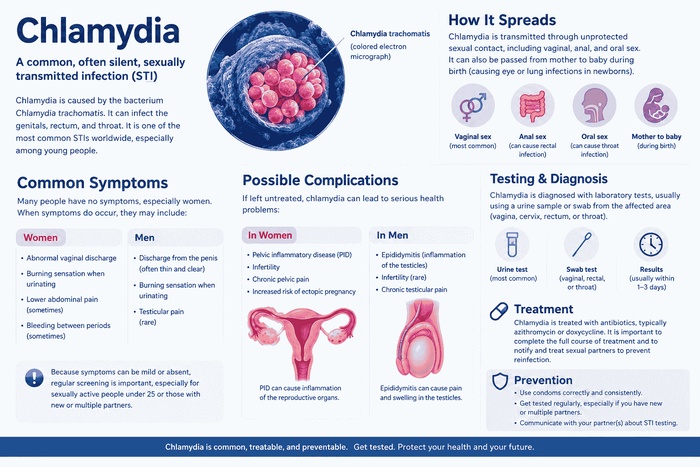
Chlamydia is caused by the bacterium Chlamydia trachomatis and is one of the most common sexually transmitted infections worldwide. The World Health Organization estimated 128.5 million new chlamydia infections among people ages 15–49 in 2020. In the same age group, estimated prevalence was 4.0% among women and 2.5% among men.
The numbers are important, but the more useful question for someone who is dating may be simpler: How can an infection be there when you have no idea anything is wrong?
Chlamydia can infect the genital tract without causing obvious symptoms. Some people may develop symptoms such as burning when urinating, unusual vaginal or penile discharge, bleeding between periods or after sex, lower abdominal pain, or testicular pain. Rectal infection can also cause pain, discharge, or bleeding. Oral infections are often asymptomatic.
When symptoms are absent or mild, there is nothing obvious telling a person to get tested.
This is why someone can enter a new relationship believing they are sexually healthy and only discover an infection during routine screening or after a partner receives a positive result.
It is also why symptoms are not a reliable way to determine whether someone has chlamydia.
This can be one of the hardest parts of dealing with chlamydia while dating.
If you and a partner test positive, it is natural to ask: Who had it first? When did it happen? Was it from this relationship?
A test can identify an infection, but it does not provide a simple timestamp showing when someone acquired it.
The CDC specifically notes that when discussing a positive chlamydia or gonorrhea diagnosis with a partner, sometimes no one knows for sure who had the infection first.
That distinction matters. A diagnosis should lead to medical care and partner notification rather than automatically becoming evidence of infidelity.
For current or recent partners, the CDC recommends evaluation, testing, and presumptive treatment when there was sexual contact during the 60 days before the infected person's symptoms began or their chlamydia diagnosis.
For couples, this can be an uncomfortable conversation, but it does not have to become a blame conversation.
 Why Screening Matters Even When You Feel Fine
Because chlamydia can be silent, screening can identify infections that symptoms would never reveal.
CDC recommendations include annual chlamydia screening for sexually active women younger than 25 and for women 25 and older who have increased risk. The U.S. Preventive Services Task Force has a similar recommendation for sexually active women ages 24 and younger and older women at increased risk. Screening recommendations differ depending on a person's sex, anatomy, sexual practices, pregnancy status, and other risk factors.
Testing can also be particularly relevant when starting a new sexual relationship. Rather than treating an STI conversation as an accusation or interrogation, some couples choose to make testing part of taking care of each other's health.
That can be a much healthier starting point than waiting for symptoms.
The good news is that chlamydia is curable with appropriate antibiotic treatment. But treatment is not something to handle alone. Partners may also need testing and treatment, and the CDC recommends avoiding sex until the appropriate treatment period has been completed and partners have been treated.
Another detail that is easy to overlook is reinfection.
The CDC recommends that people treated for chlamydia be retested about three months later, even if they believe their partners were treated. Repeat infections are commonly associated with reinfection rather than the original treatment failing.
Untreated chlamydia can cause complications. In women, it can lead to pelvic inflammatory disease and, in some cases, infertility, ectopic pregnancy, or chronic pelvic pain. Men can develop epididymitis and related complications, although serious complications are less common.
So the absence of symptoms is not a reason to ignore a positive result.
A chlamydia diagnosis can bring a very different kind of concern: Will someone still want to date me if I tell them?
That fear can sometimes become bigger than the medical issue itself.
Chlamydia is a common, treatable bacterial infection. Having it does not tell someone whether you are responsible, trustworthy, clean, or capable of having a healthy relationship. What matters is how you handle the diagnosis: getting appropriate treatment, communicating honestly with relevant partners, and taking reasonable steps to protect each other's health.
For people dating with an STI diagnosis, finding someone who understands that sexual health is part of real-life relationships can also make disclosure less intimidating.
At PositiveSingles, we believe an STI diagnosis should not force someone to put their dating life on hold.
Our community is built for people living with STDs, including herpes, HPV, HIV/AIDS, and other sexual-health conditions. You can connect with people who understand why testing, disclosure, privacy, and sexual health conversations matter—without having to explain your diagnosis from the beginning.
Privacy is also an important part of how we support our members. PositiveSingles provides privacy-focused features and settings that give you more control over what you share and who can see it. You can also explore our blogs and success stories to learn from other members’ experiences, find encouragement, and see how people have navigated dating and relationships after an STD diagnosis.
You can create a profile, meet people who understand the realities of dating with an STD, and take conversations at your own pace.
Your sexual health is one part of your story—not the whole story. Join PositiveSingles today and connect with people who understand. Keep Positive, Find Love, Support & Hope!